


Beyond the Battle

-Musings by Veronica Yacco

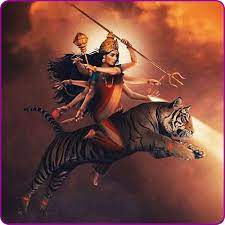
Navaratri is the celebration of the victory of light over darkness and of the liberation from our suffering. The celebration is traditionally dedicated to Durga, the warrior Goddess who appears to fight the armies of demons who are threatening all of Creation. In the stories, the Gods are overwhelmed and collectively they pray to Shakti, the Mother of All Creation, and she manifests as Durga, promising to liberate the world from the darkness of the demons. And She does. She manifests as many forms to combat all the shapes that darkness takes and She is victorious and we are saved. At least until the next form of darkness takes shape and our fear returns.
The beauty of the story of Durga is that She will come again and again to help us confront and eventually defeat, or transcend, the darkness that rises within us. The flipside of this story is that as long as we are afraid of the darkness that appears, and feel we need to be saved, we will be locked in an endless cycle of battles. Durga's work will never be finished. But Durga's strength is a place to realize our ability to meet darkness in all of its forms and to realize the relationship we have to that darkness, how we are entangled with it. Without that awareness we cannot even fathom what it means to be "free" from the darkness. That discovery comes from seeing ourselves not only as the liberating power of Durga, but of the darkness itself, and even as the space from which they both originate. To explore this root of what it means to be liberated or saved, we start with what it means to be in suffering. And for that we do not turn to Durga, we turn to Dhumavati, the "Smokey One."
Dhumavati represents the Void, where all things originate and all things will be dissolved back into nothingness. It is a space of non-doing and yet endless potential that has no form. In the world, Dhumavati's gifts are the wisdom found from hitting rock bottom. She represents the meaninglessness of striving and the heavy fog of ignorance. She is the place to feel the deepness of broken-heartedness, loss, failure, disappointment, grief. She is the knowing that you cannot outrun death nor can you avoid the pain you feel simply by contrasting it with a temporary happiness. She reminds us that our efforts to continuously chase comfort or happiness will ultimately be fruitless if we don't recognize what it is we are really running from while we chase. She reminds us there is nowhere to go, but in. She isn't pretty to look at. It's even said she is difficult to approach since She tends to cause arguments and misunderstanding. Her presence will cut through our thin skin and sensitive feelings to require us to examine why we are afraid. Sounds fun right? But there is blessing in her apparent harshness. When we are at the end of our rope, or we have lost hope in ever escaping our issues, She is the one that offers us the way out from under the weight of our suffering. She gives us a path to the Truth of who we are, but doesn't allow us to rest halfway in an idea of who we would like to be. All of the limited ideas we have of ourselves She pulls away until we are left with a much bigger Truth. She does not promise us that we are Light and Love in the way the Self is often described because our ideas of those things are very specific and exclusionary. They are words to seek comfort and pleasure in our identity. Instead, Dhumavati demands that we see the Self as more than those ideas. She presents us the reality that the Self is the Source of all darkness as well as light and that you cannot separate the two concepts from each other. The reality we cannot really fathom is that neither light or dark really exist as distinct "things", but only as movements of perception. Similar to how we can watch the cycles of day and night but know that the sun never disappears from existence, we can observe darkness and light moving and transforming within our own experience and know that consciousness (the Light) itself never disappears or wavers. The Truth Dhumavati reveals is that EVERYTHING we experience is this play of light and dark and the Self is our awareness of Being that is not defined by those movements or limited by them in any way. Imagine for a moment you are in a movie made for children- maybe a combination of Toy Story, where the toys come to life when no one is watching, and Alice and Wonderland, where the reality of dreams and life are entwined. Imagine in this movie world you are in the story of Durga, surrounded by demons, fighting on all sides, a dark haze in the air. Fear and adrenaline surge through you, hope and desperation take turns rising in your mind. Failure and victory are muddled because the battle is never-ending. And then someone says "Cut!" and the lights come on and you look around and find you are surrounded by props. The monsters you were fighting are shown to be toys that are no longer animated, and drawings on the walls that looked scarier in the half-dark than they do in the light. The weirdness of the battlefield comes into focus and it's just a room full of things, your things. You are safe, no longer under threat. Look around you. What are the shapes of the monsters that are now toys? What was terrifying about them and what continues to draw you to them? If this is your room, why do you keep what you see around you? What meaning does it have for you? What would happen if it all went away?
Dhumavati asks us to look at our inner experience like this example. Everything you have is tied to you through what it means to you. That includes our joys and our suffering. To see these represented through objects helps us to understand what it means to know ourselves beyond the definition of what we have experienced. What is left over after all the things called "joy" and "suffering" are removed? That is the Self. Awareness. Divine Consciousness. The place where Light and Love truly have no conditions and what we call darkness is known to be the same stuff as what we call light. When we touch that awareness it is like yelling "Cut" and turning on the Light and we can see what couldn't be seen before. We are in a room and there are things all around us, but the way they animate requires our participation to continue. The mind creates the movie, sets up the props, and defines the roles of the toys, and we play out the energies of both the hero and the villain, and the victim too.
From her seat in her broken cart, Dhumavati makes that call to wake up to our situation and acknowledge what needs to happen in order for our endless battles to end. She makes us aware that what we think we know gets in the way of seeing what is True. She asks us to look at what we use as our definitions for life and the meaning we create through our experiences. Then she reminds us that we are the author of the movie script. All the props are simply rented, they don't belong to us at all. The room is just a set. We can rearrange the furniture, re-imagine the characters, re-define the roles and make a better movie, but we still won't be free. We have to look at what we cling to and know that the endless Love that we are is tangled up in that clinging. As we ease ourselves back from viewing our experiences as definitions of who we are or as a way to become who we want to be, we are free to feel with honesty who we already are and the potential that is inherently there in our light and our darkness. We can touch that Love within us and see how it has always flowed through us, even through our suffering. When we can set the toys down, walk out of the room and set aside the story of who we thought we should be, that Love gets untangled from the experiences (the things) and we can feel the full force of it, so much so that we realize it's all that has ever truly been constant and that it is the one thing that cannot be given up because it is what we are (we don't even have to use "who" anymore).
The story of Navaratri is told through the narrative of winning a great battle against the demons that threaten the world. We usually start from the perspective of the victim (the Gods) and carry the story through as the hero (Durga). This time let's start with the darkness. Let's begin from where we make that plea to Durga to save us- lost, confused, broken-hearted, and scared. Before Durga arrives, can we invite Dhumavati to give us the wisdom to see what's truly happening, to see the interplay of light and dark and find the Love that underlies both? Can we start with knowing that the Love in us is tangled up in these things we call demons and they keep coming to us (and we keep seeking them out) so we can understand what that Love is about. Winning the battle is not enough. Knowing what endures whether we win or lose is what brings liberation. In Dhumavati, as all forms are destroyed, we find the Love that is unveiled in that dissolving. Her gift is that when we hit rock bottom in ourselves, and are able to deeply surrender, even in failure, what we are met with is that endless Love. Let's start with That.
Happy Navaratri!
OM dhum dhum Dhumavati Svaha!


Comments